The mission of RHHP..

The mission of RHHP is to provide a Christian community setting where persons of various cultures learn from each other, the surrounding neighborhood, and life in Baltimore city. We believe that people's lives are blessed by being part of faith communities.

Sunday, November 14, 2010

This old house..


Being a hundred year old house, RHHP merits its own maintenance crew. In last Friday's episode in the continual upgrading of RHHP, a plumber who has been re-plumbing the main floor bathroom accidentally discovered a hole in the side of the furnace through which the gas flame is visible. This called for the furnace to be turned off and is only to be turned on when someone is supervising it. So Ellen was "trained" to turn on the furnace so that the house may continue to be heated and have occasional hot water for showers. Residents wanting hot showers are to coordinate with Ellen as she has to stand guard outside the furnace room to keep an eye on it. (See photo above.) Fortunately, the weather has been mild and no one has suffered unduly from the shivers.

The good news is that the Brubaker Plumbing crew from Lancaster, PA, will be here on Tuesday to replace the furnace. They should be familiar with our furnace room after having spent an entire day a couple of years ago replacing one of the boilers.

RHHP Visioning Meeting


Representatives of the RHHP Committee, Asylum Seekers Housing Network, the Mennonite Voluntary Service unit, residents and the house managers met yesterday to review the progress of RHHP over the past eight years, especially the period since the visioning meeting in May 2008, and to look for ways to strengthen the RHHP's fulfillment of its mission in the future. Ruth Clemens ably guided the group through the three hour process. We reviewed the mission statements of the ASHN and MVS to ensure that their missions are in support of the RHHP vision. The respective groups came away with assignments to complete. The group also discussed different ways the community residents, ASHN clients and VSers could be better integrated.

Wednesday, October 20, 2010

Two RHHP birthday girls


We celebrated two birthdays tonight. Kendra and Sarah had their birthday this week. We all had delicious birthday cupcakes.

St Francis Center community potluck


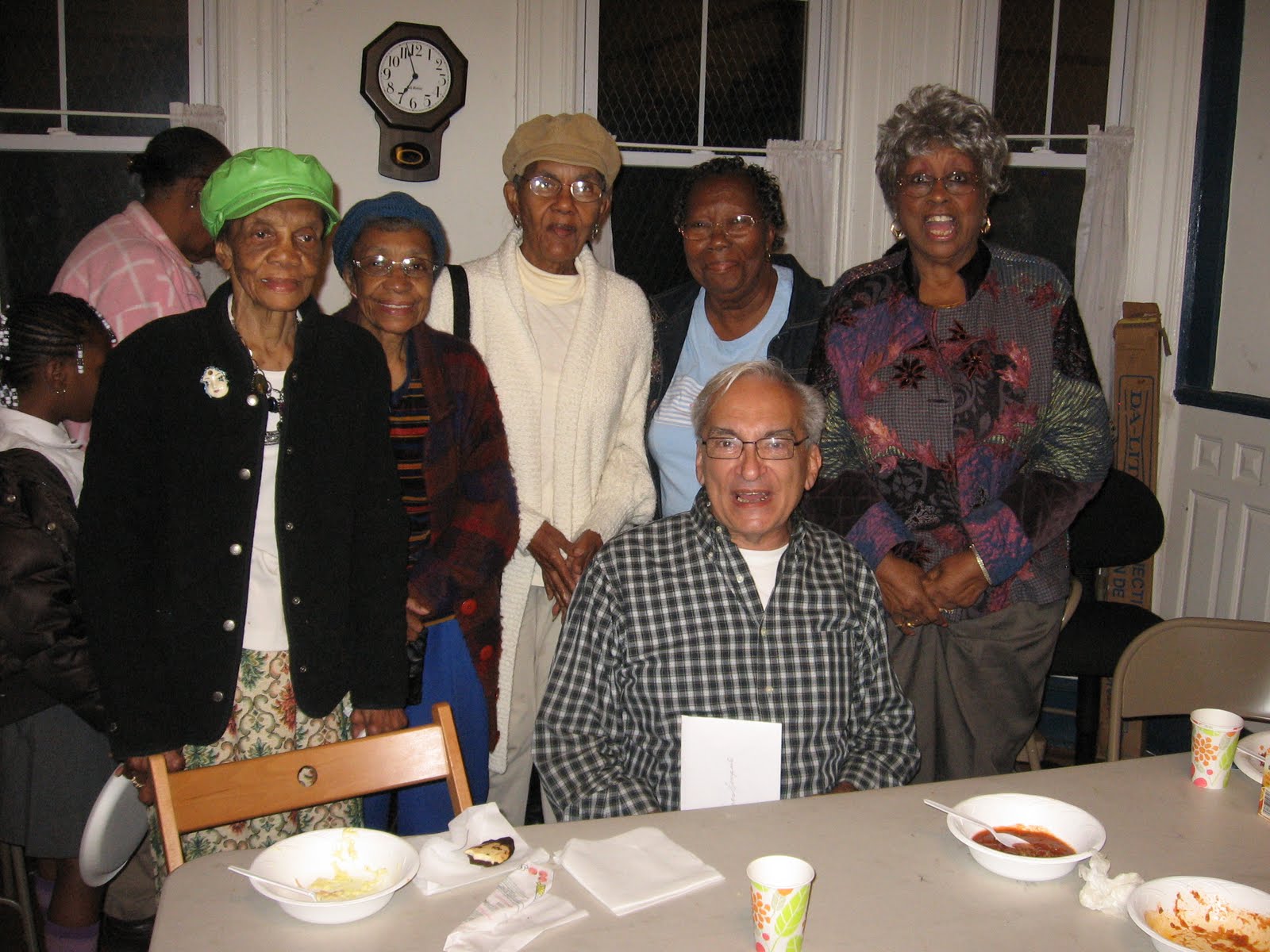
Tonight was the St Francis Center community potluck. An email had gone out last week letting us know that it will be a surprise celebration to honor Fr Tom's retirement after 48 years in the neighborhood. It was a good turn out. I sat with a group of elderly women who made up the Druid Hill Neighborhood Group who presented Fr. Tom with a card and some cash. These women were part of the great migration from the south. Gloria, who sat to my left, had lived in Reservoir Hill since 1956 and had seen the neighborhood through good and bad times. It was a history lesson for me to talk to them. She described how, in 1992, the city had condemned and demolished a row of businesses on Whitelock between Brookfield and Linden because of the drug and crime around it. The plan had been to redevelop these lots and had been pushed through by some white folks who had recently moved into Reservoir Hill. Unfortunately, the plans to redevelop the lots were never carried out and to this day, we still have a row of empty lots including the one Ellen and I adopted.

I also got to visit with Madeline and Jacob, a young couple and their infant. They moved out here from Berkely, CA, after finishing school. They bought an apartment building on Madison, one block west of RHHP, and instantly became landlords to tenants they inherited from the previous owner. After evicting the criminal elements and finding new tenants, they set about starting a cafe on the ground floor of their building. Unfortunately, they ran into problems with the contractor and ended up firing him but loosing some money in the process. I think that I am seeing a trend here. It seems that the energy driving the changes in Reservoir Hill is coming from the infusion of people with pioneer spirits and visions of what they want in their community.

Reservoir Hill Improvement Council annual meeting


This year's RHIC was held last night in the fellowship hall of the Beth Am synagogue one block north of RHHP. It was a well attended affair with numerous awards handed out to people who have contributed to the improvement of Reservoir Hill. Many were individuals who have lived and worked in the neighborhood for many years. The group of neighbors who started the Whitelock Community Farm were also honored. Others were partners from the city departments, John Howard Eager School and community center. The mayor sent an assistant on her behalf. It made me realize how many pairs of hands it takes to make a neighborhood a good place to live in. Father Tom was honored and his retirement from the ST Francis Center was recognized. Here is a snap shot of Fr. Tom accepting his award.

Whitelock Community Farm festival


Last Sunday, the group of neighbors who live on Brookfield and converted the empty lot on the corner of Brookfield and Whitelock into a farm held its farm festival. The event was blessed with spectacular weather. There was face painting and apple bobbing for the neighborhood kids, pumpkin carving, spiced cider and several boxes of Dunkin Donuts. Justin brought out his three hens and wowed the kids. Many of them had not touched poultry of any sort. The turn out was very encouraging and I got to meet many of the neighbors. The new rabbi of Beth Am temple was there. He moved into the neighborhood when he took over the congregation and appears to be making a deliberate effort to reach out to the neighborhood. Then I met Justin and his wife Rebecca who recently moved here after completing school in Michigan. Justin teaches middle school in a public charter school and his wife is a social worker. Justin's dream is to begin a ministry to house homeless people in their house and to help them get on their feet. Rebecca's passion is bread baking and dreams about starting a bakery in Baltimore. She also has a passion for good food and hopes to introduce good food to the neighborhood. In erecting the greenhouse, she hopes that the farm can extend its growing season. The plan is to eventually produce enough vegetables to be able to sell them cheaply to residents. The group also hope to start a farmer's market in the lot across the street from the farm. It is amazing what these few families have done to this once empty weed and garbage filled lot.

Then I met Cynthia and her husband who lives across RHHP on Eutaw Place in the house that they bought from Brian and Cheryl Martin who once directed the YES program. Glynette, our neighbor from the north was there with her son, daughter in law and grand daughter. Glynette just returned from a couple of months in Florida taking care of some family business. I offered to let her have her own plot of land in the RHHP garden. She has a spigot right near the garden and she can run a hose to our garden. She thought that was a good idea and she was interested in having her own garden next to mine.

Thursday, September 30, 2010

English First?

It's been a while since have I seen any coverage in the media about the English First movement. This is a movement made up of folks who fear that foreign languages(primarily Spanish) are encroaching into official government business and who are disturbed when some government entities accommodate non-English speakers by translating forms into various languages. These same people feel that legislation is needed to make English the official language of America and to stop the erosion of its traditional standing as the sole language used in official government business.

I want to share with you one instance in which no legislation is needed to encourage two immigrants to learn English. In recent weeks I have noticed that two of my asylum seeker house mates have been waking up at 5am and leaving the house at 5:30 am. I found out tonight that they recently began free English classes at the Baltimore County Community College in Dundalk just outside of Baltimore City. Instead of taking a bus downtown to catch the number 40 bus to Dundalk, they have been riding their bicycles. I looked up the route on Google map and discovered that it is more than 9 miles on city surface streets and partly by freeway which is undoubtedly a more direct route. Their more circuitous route is very likely more than 10 miles each way. It takes them an hour each way which is about the same length of time by bus and they save the bus fare.

I think this illustrates the folly of measures designed to force immigrants to learn English. Given the opportunity, most new comers will learn English without coercion. Most of them know that the ability to speak English is the first rung on the economic ladder and determines the height to which one can reach. Instead of devising ways to force immigrants to learn English, it would be more productive to increase the availability of English classes to immigrants, especially those who have to work while learning English.